What the code allows.
A roof-over (the code calls it a recover) is a new layer of shingles nailed over the old ones. The building code allows it only when all of these are true:
- The roof has just one layer on it now. Two or more existing layers have to come off.
- The old roof isn't water-soaked or deteriorated to the point it can't hold a new one.
- The old covering isn't slate, clay or cement tile.
Anything else gets torn off down to the deck.
What a roof-over saves.
The tear-off: the labor to strip the old roof, and the dumpster to haul it away. On a typical house that's a real number, which is why it gets offered. It can be a little faster, too.
What it costs you.
Nobody sees the decking
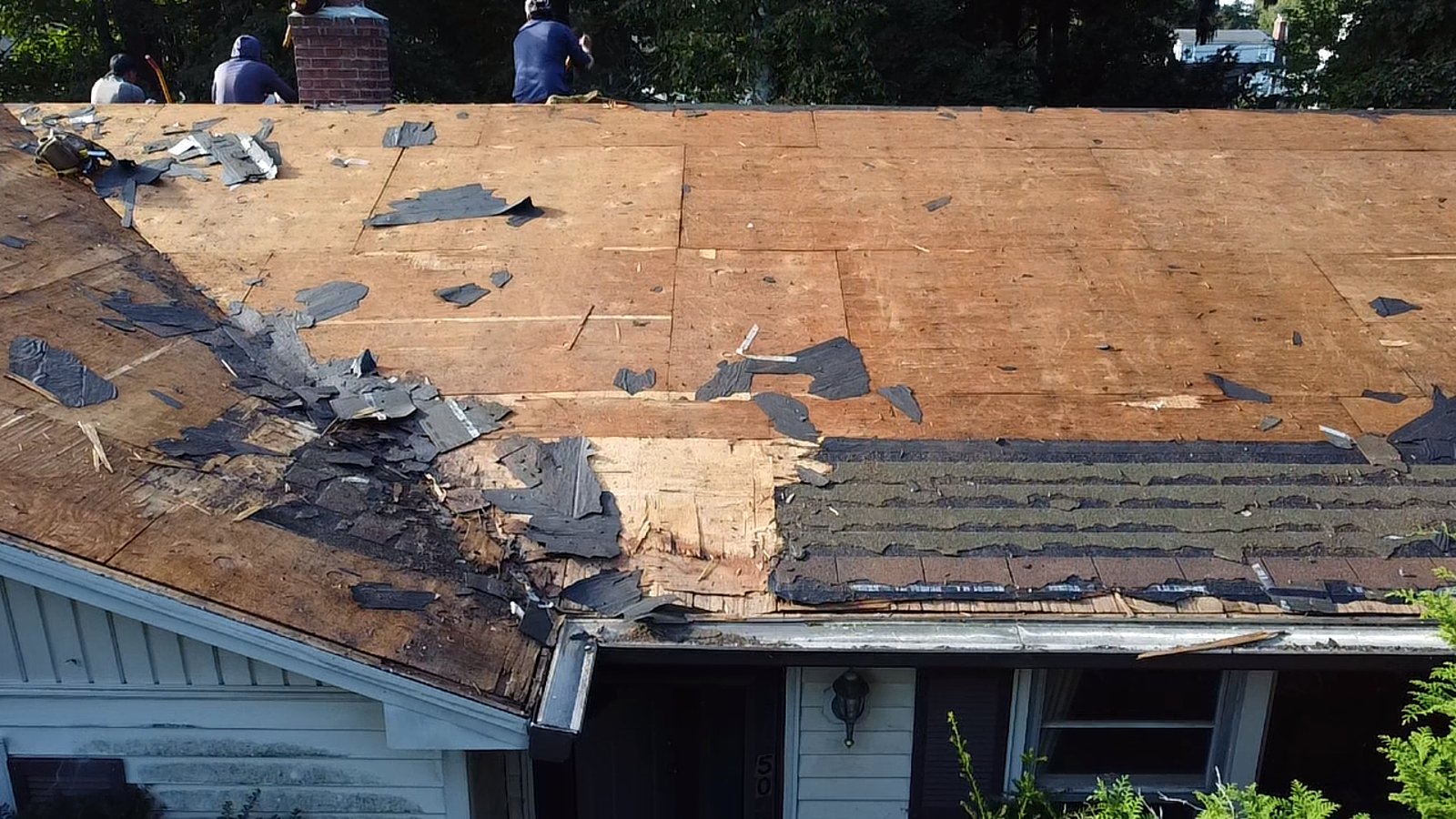
Soft or rotten boards stay under the new roof. On a tear-off we see every board, and bad ones are priced per sheet before we start. The Hamden roof in the photo had three layers on it and rotten decking underneath.
The ice barrier can't do its job
Connecticut requires an ice barrier at the eaves, and it works by bonding to the deck and sealing around the nails. Laid over old shingles, it's sealing to the old shingles instead.
Flashing gets patched
Chimney, wall and valley flashing can only be replaced properly with the old roof off. Over the top, it usually gets bent over or caulked.
Bumps show through
New shingles follow the shape of what's under them, so curled or uneven old shingles telegraph through the new roof.
It adds weight
A second layer adds a few hundred pounds for every 100 square feet of roof, on top of the first.
The next roof costs more
Two layers to strip instead of one. You've pushed the tear-off to the next roof, at a higher price.
Some manufacturers cover a roof-over differently from a tear-off. Read the terms before you agree to one.
How we quote it.
Every square on our quotes includes tearing off one layer, down to the deck. Extra layers are their own line, so you can see what they add. Decking is priced per sheet before tear-off, and if we find bad boards, we photograph them and show you before they're replaced.
Then the roof goes back on from the deck up: ice and water shield, synthetic underlayment, new drip edge and flashing, ridge venting, shingles. Every layer is in our parts of a roof guide.
Code references are general information, checked November 2, 2026. Your town's building department has the final word on your house.
LET’S CLEAR A FEW THINGS UP.
Can you put a new roof over an old roof?
Code allows one new layer over a single existing layer, if the old roof is dry and sound. Two existing layers, a deteriorated roof, or slate and tile all mean a full tear-off.
How many layers of shingles can a roof have?
Two at most. If a roof already has two layers, both have to come off before a new roof goes on.
Is it cheaper to roof over shingles?
Up front, yes, because you skip the tear-off. But nobody can see or fix the decking, the flashing gets patched instead of replaced, and the next roof costs more to remove.
How do I know how many layers my roof has?
Look at the edge of the roof along the gutter or the rake, where you can often count them. The inspection tells you for sure, and extra layers are priced on your quote.